
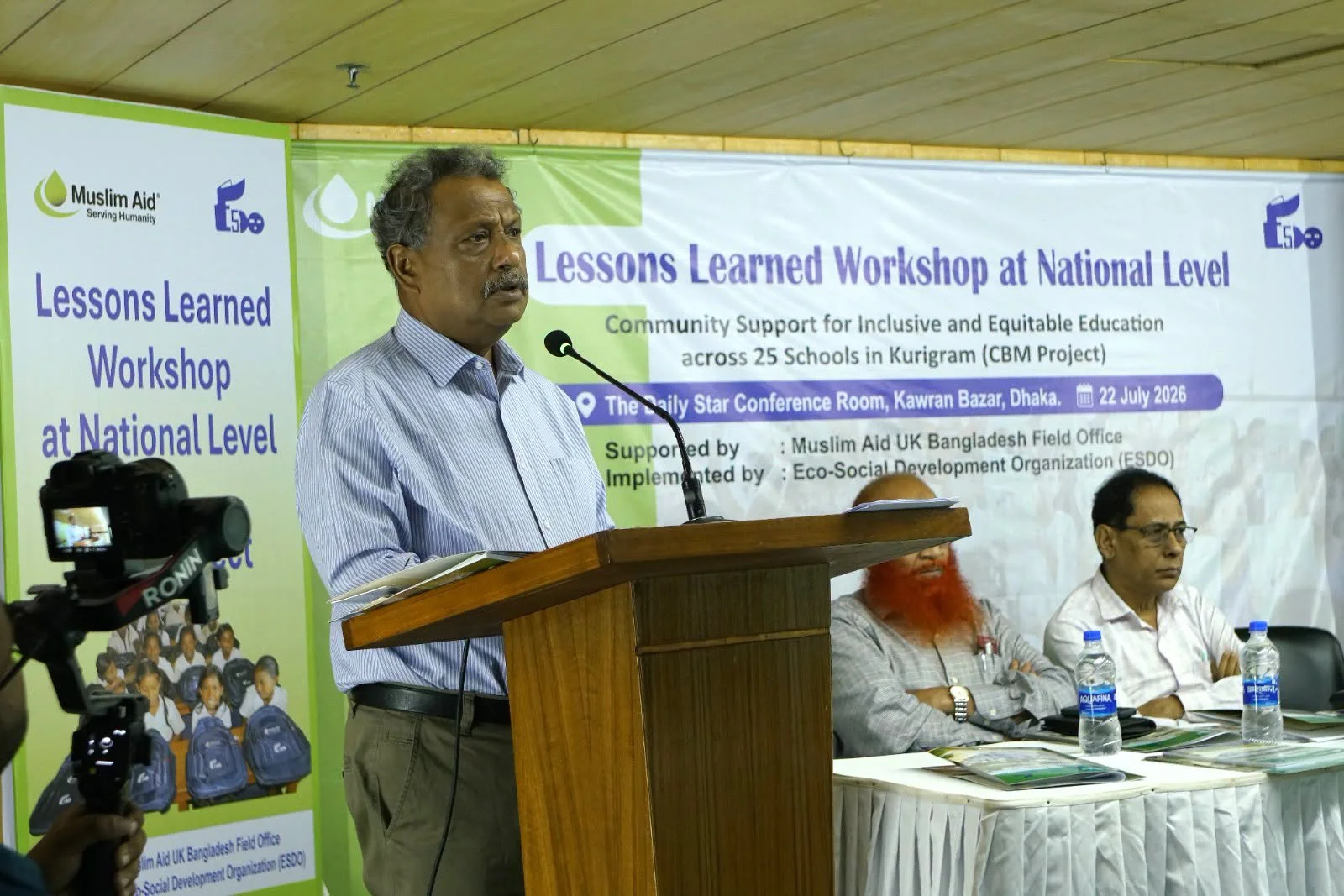
On 22 July 2026, the Eco-Social Development Organization (ESDO), with financial support from Muslim Aid UK Bangladesh Field Office (MABFO), successfully organized a National Learning-Sharing Workshop at The Daily Star Centre, Dhaka, marking the successful completion of the five-year “Community Support for Inclusive and Equitable Education across 25 Schools in Kurigram District (CBM Project).”
The workshop brought together senior government officials, development partners, education professionals, NGOs, teachers, students, parents, and media representatives to reflect on the project’s achievements, lessons learned, best practices, and future priorities for advancing inclusive education in Bangladesh.
The event was honored by Dr. Mir Zahida Naznin, Director (Planning and Development), Directorate of Secondary and Higher Education (DSHE), as the Chief Guest. Mr. Md. Farhad Alam, Director, Directorate of Primary Education (DPE), and Mr. Mohsin Siddiqui, Country Director, Muslim Aid UK Bangladesh Field Office (MABFO), attended as Special Guests. The session was chaired by Dr. Md. Shahid Uz Zaman, Founder and Executive Director of ESDO.
Implemented from 1 July 2021 to 31 July 2026, the project has transformed learning opportunities for disadvantaged, marginalized, and children with disabilities across 17 secondary schools and 8 primary schools in Kurigram District. Key interventions included inclusive school infrastructure, girl-friendly and disability-inclusive WASH facilities, teacher capacity development, student leadership, Menstrual Hygiene Management (MHM), Disaster Risk Reduction (DRR), safeguarding, environmental initiatives, and community engagement.
The workshop highlighted significant achievements, including improved student attendance, reduced dropout rates, enhanced learning environments, and increased participation of children with disabilities and other vulnerable learners. Participants emphasized the need for stronger collaboration among the Government, development partners, educational institutions, and local communities to further strengthen inclusive and equitable education across the country.
The recommendations generated during the workshop are expected to contribute to evidence-based policymaking, strengthen future education initiatives, and support the nationwide expansion of inclusive education in Bangladesh.
Together, we can build an education system where every child—regardless of ability or background—has the opportunity to learn, thrive, and succeed.
Muslim Aid and ESDO Host National Learning-Sharing Workshop to Advance Inclusive and Equitable Education
29